
What a 1024 Wh Battery Means for Real World Mobile Computer Station Performance
Imagine that your team is on the floor, and the workstation is where it needs to be. Everything is in place and ready – until the battery dies.
Does this scenario seem similar or sound familiar?
If it does, there’s a larger problem besides your charging cart or solution. Rather, it’s the battery capacity sitting behind the spec sheet and whether those numbers hold up across real operational conditions. A figure like “8+ hours” means something very different depending on what’s plugged in, how the unit is being used, and what the battery chemistry can sustain over time.
In short, you need to look beyond “hours” and shift your attention to watt-hours. Once you do, you need to choose a charging solution with “1024-Wh battery” written in the spec sheet.
What Watt-Hours Actually Measure
Battery capacity gets talked about in hours, but hours are a function of load. A battery running a laptop draws far less power than one running a laptop, a monitor, a label printer, and a barcode scanner simultaneously.
Watt-hours give you a more honest number because they measure total energy stored, not estimated runtime under ideal conditions.
A 1,024 Wh battery holds roughly the same energy as running ten 100-watt devices for about an hour each, or one 100-watt device for over ten hours. If a mobile computer station is running a display, a computer, and one or two peripherals at once, that capacity is equal to a full shift of continuous operation.
Why Lower-Capacity Batteries Create Operational Risk
A workstation carrying a monitor, laptop or micro PC, printer, and scanner can draw anywhere from 100 to 300 watts depending on the hardware. With a 400 Wh battery, your charging station or hub will be able to power a 150-watt load for about three hours, which isn’t a full shift by any reasonable standard.
The problem happens when you need lengthier charging coverage. When a battery fails, you won’t know until a member of your faculty or team complains of unfilled battery bars on the screen.
What 1,024 Wh Gives You in Practice
At a moderate combined load of around 120 watts, a 1024 Wh battery is sufficient for over eight hours of continuous operation. That capacity covers most standard shift lengths without a recharge.
Does your floor or school have long or back-to-back shifts where the same equipment is shared? With a mobile computer station like the MobilePro and its hot-swapping feature, you can insert a fully charged spare battery without powering the cart down. This way, operations continue without interruption while the depleted battery recharges separately.
Look at Battery Chemistry
Capacity tells you how much energy a battery stores, but chemistry determines how reliably it delivers that energy over time, under stress, and across hundreds of charge cycles.
Most mobile power solutions use lithium-ion NMC chemistry, which offers high energy density but degrades more quickly under high temperatures and deep discharge cycles. That’s bad news for battery health if you’re charging for three shifts.
LiFePO4 and What It Means for Longevity
The 1024 Wh battery in the Bretford Power System uses Lithium Iron Phosphate (LiFePO4) chemistry.
LiFePO4 runs cooler, degrades more slowly, and maintains structural stability even under conditions that would compromise other chemistries. As a result, you get a battery rated for 2,000 cycles to 80% capacity, compared to the 500 to 1,000 cycles typical of NMC alternatives.
Built-In Safety Architecture
High-capacity batteries in industrial environments carry real safety considerations. Thermal runaway, over-voltage, and short circuits are genuine risks when a battery system isn’t designed with active safeguards.
The Bretford Power System integrates a Battery Management System (BMS) that monitors:
- Cell balance
- Temperature
- Charge state
It pairs with a pure sine wave inverter to deliver stable, clean power to connected devices. So there’s no need to worry or frequently check charge status if you’re plugging in sensitive electronics like displays and computers.
The Power of a 1024 Wh Battery Across Industries
Based on the feedback we’ve received, our mobile powered workstation functions well across various sectors and environments thanks to its 1,024 Wh battery.
Manufacturing and Warehouse Operations
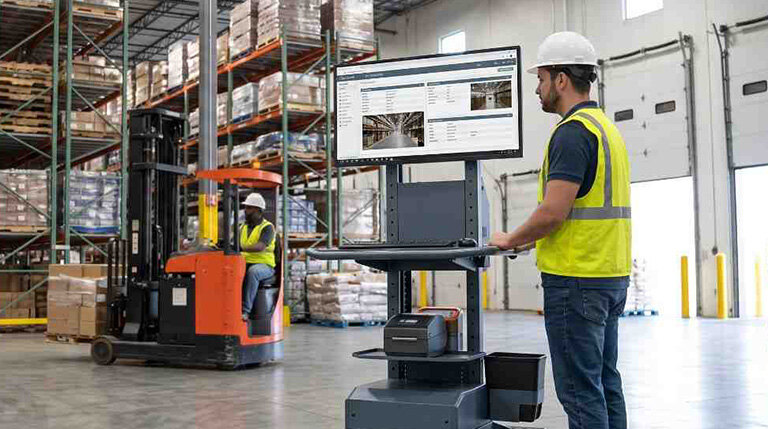
On a warehouse floor or production line, the workstation moves between stations, follows workflows, and needs to stay operational across an entire shift without a power tether.
Full-shift battery capacity removes the fixed station dependency entirely, cutting the dead time associated with walking back to charge or waiting for a swap.
Healthcare and Service Environments
In healthcare settings, mobility means bringing computing power directly to the point of care. When a workstation loses power mid-interaction, it interrupts a workflow with real downstream consequences.
Eight-plus hours of capacity on a single charge, with hot-swap capability as a backup, keeps those interactions running on schedule.
Transportation and Logistics
Below-the-wing operations, cargo management, and ground support all share one hard constraint — there are no outlets where the work happens.
For this reason, the last thing you need when you’re shopping around for a mobile station is a false promise of mobility when actual specs require either frequent charging or wall-mounted power.
A mobile computer station with high-capacity onboard power operates wherever the operation does, fully independent of facility infrastructure.
Battery Capacity Is More Than a Technical Detail on a Spec Sheet
When you’re evaluating a mobile workstation for operational deployment, battery capacity deserves the same attention as form factor, display support, and build quality. After all, a unit that runs out of power before the shift ends doesn’t deliver on the mobility promise. It doesn’t matter how well it performs in every other respect.
1,024 watt-hours, LiFePO4 chemistry, hot-swap capability, and a 2,000-cycle warranty are the specs that determine whether a workstation actually performs across the conditions your operation runs in.
Do you need a mobile powered workstation that meets those standards? Look no further than Bretford.
Reach out, and get a free quote on our mobile computer stations and other 1024-Wh battery-powered solutions.
